
Industries
The elevator business almost nobody leaves
Independent elevator service companies have customers who rarely switch and work the safety code requires, yet much of that work still runs on paper. Every inspection report has to become a proposal, and someone in the office has to write it.

Gary O'Neill, Founder & CEO, Setanta.
6 min read
Key findings
92.4%
Elevator service customers rarely leave. Otis, the largest provider, reported 92.4% retention of its global maintenance portfolio for 2024. One industry paper puts private equity platforms well above 90% on the portfolios they buy.
30%
About 30% of US elevators and escalators are maintained by privately held independents, by one industry estimate.
1
The code makes the work recurring. Under ASME A17.1 as adopted in Wisconsin, for example, Category 1 tests run every 12 months and Category 5 tests every 5 years, and each one leaves a record.
We think the bottleneck is the office. Every inspection report becomes a proposal someone has to write. That is where we think Claude can help, with a person approving every price.
Why we looked at elevators
We keep a list of industrial businesses that look sleepy from the outside and are very hard to dislodge from the inside. Elevator service sits near the top. A building needs someone to maintain its elevators, periodic tests and inspections, and a paper trail to show for both. Once a provider is in, switching is real work for the building: new contracts, notice deadlines, records to move.
We want to be clear up front: we have not built anything for an elevator company yet. This is what we learned from public sources, and where we think the paperwork could move faster.
How loyal are elevator service customers?
The best public number comes from the biggest player. On its fourth quarter 2024 earnings call (January 29, 2025), Otis said its maintenance portfolio retention rate went "from 93.5% or so to 92.4%." Otis maintains about 2.4 million units worldwide. That is a global figure for one large company, not a figure for independents, and we use it only as a benchmark.
For private equity platforms, an industry paper by Dominik Sachsenheimer, published by Elevator World, says that "customer retention rates for PE consolidators have generally been well above 90% of acquired portfolios."
We could not find a public retention figure for independent providers. If you run one, your own churn table is the number that matters.
Part of the loyalty is in the contract. A guide from one service company, Quality Elevator, notes that many maintenance contracts "renew automatically for one-year or multi-year terms" unless written notice arrives by a deadline, with notice periods "commonly 30, 60, or 90 days." Contract terms vary, so treat this as a common pattern, not a rule.
Who maintains America's elevators?
| Provider type | Share of US units |
|---|---|
| Original equipment manufacturers (OEMs) | about 60% |
| Privately held independent service providers | about 30% |
| Private equity backed platforms | about 10% |
Source: Industry estimate, Sachsenheimer, Elevator World, Dec 1, 2025 (presented at the 2024 International Elevator & Escalator Symposium). This is one author's estimate, not a census count.
The Census Bureau does not count elevator companies on their own. The closest category is NAICS 238290, Other Building Equipment Contractors, which includes elevator and escalator installation but also commercial doors, conveyors, millwrights and machine rigging. So the counts below are an upper bound for elevator firms, and the size pattern is the useful part.
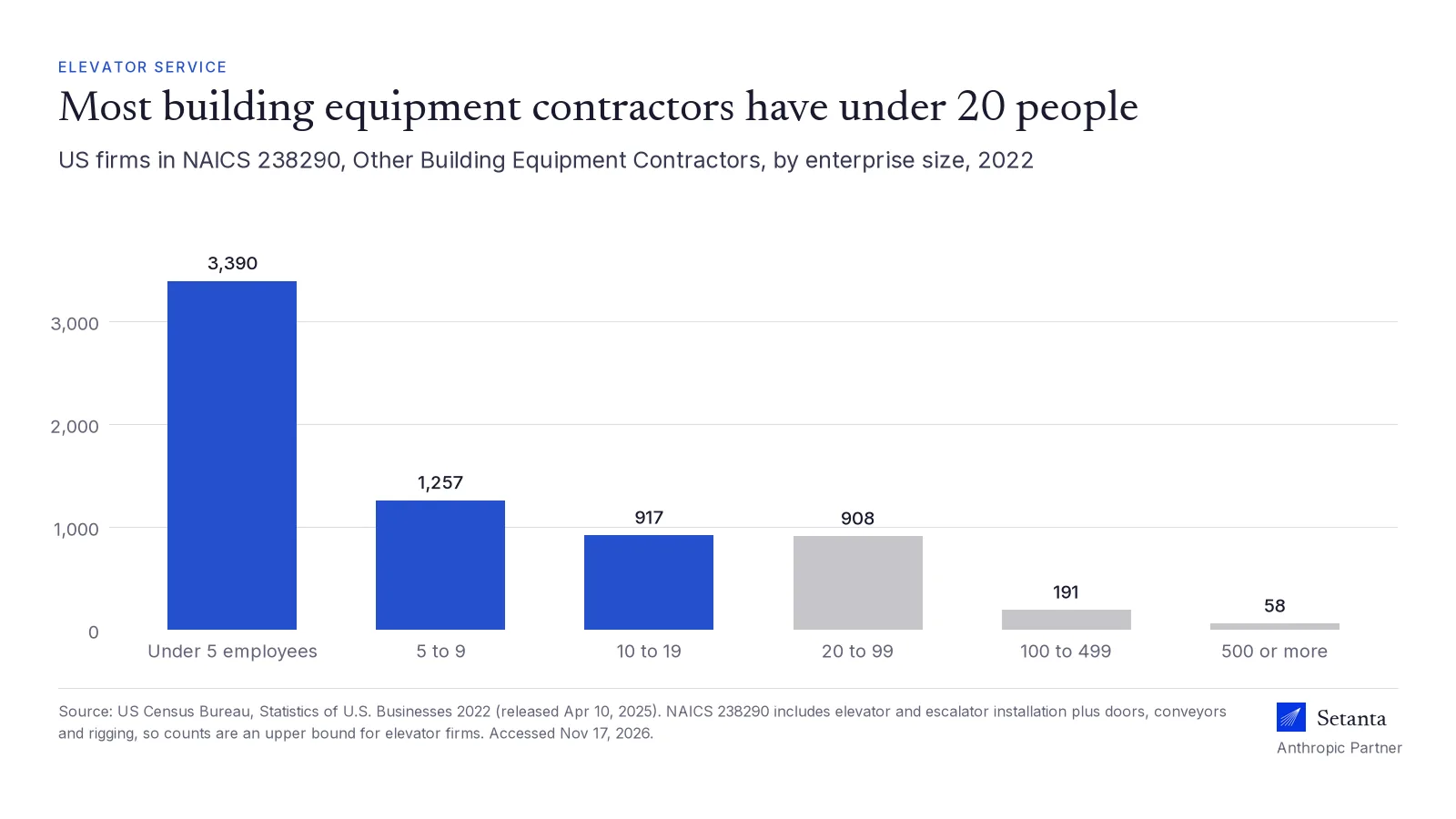
| Enterprise size | Firms | Employees |
|---|---|---|
| Under 5 employees | 3,390 | 5,774 |
| 5 to 9 | 1,257 | 8,533 |
| 10 to 19 | 917 | 12,637 |
| 20 to 99 | 908 | 34,327 |
| 100 to 499 | 191 | 30,910 |
| 500 or more | 58 | 50,877 |
| Total | 6,721 | 143,058 |
Source: Census SUSB 2022, released April 10, 2025. Our arithmetic: 82.8% of firms have under 20 employees, and the 58 firms with 500 or more hold 35.6% of employment.
Most of these companies are small. A handful of large ones employ about a third of the people.
Why the code keeps the work coming
ASME A17.1/CSA B44, the Safety Code for Elevators and Escalators, is in ASME's words "the accepted guide throughout North America" for the inspection, testing and maintenance of elevators. States adopt it into their own rules, so the details vary by state.
| Requirement | Example | Source |
|---|---|---|
| Category 1 tests every 12 months | Wisconsin: "All category 1 tests must be performed at 1-year intervals" | Wisconsin DSPS |
| Category 5 tests every 5 years | Wisconsin: "All category 5 tests must be performed at 5-year intervals" | Wisconsin DSPS |
| Test records kept with the maintenance records | Wisconsin cites ASME A17.1 8.6.1.4.1(b) | Wisconsin DSPS |
| Testing witnessed and reported | Pennsylvania, starting Dec 20, 2026: a code official witnesses periodic tests and submits a report within 15 days | 34 Pa. Code § 405.8, as amended effective Dec 20, 2026 |
Rules vary by state; check your authority having jurisdiction.
Every test and inspection produces paper, and some of that paper is revenue waiting to be written up: a deficiency the inspector noted, a repair the building owner has to approve, a modernization the equipment now needs.
Who can do the work?
The people who can do this work are few, and they take years to train. The Bureau of Labor Statistics counts about 24,700 elevator and escalator installer and repairer jobs in 2025, 89% of them at building equipment contractors. Most learn through a 4-year apprenticeship, and most states require a license. BLS projects about 1,900 openings a year through 2035, most of them to replace people who leave.
With a workforce this small and this slow to train, every hour a mechanic or office lead spends on paperwork is an hour off a route or away from a sale.
Where the paperwork piles up, and where AI fits
This table is our view of the office workflow, drawn from the code requirements above. It is a hypothesis to test, not a finding.
| Document | What has to happen | What Claude could draft | Who decides |
|---|---|---|---|
| Inspection report with deficiencies | Turn each finding into a priced repair proposal | A proposal in your format, built from your past proposals, with code references flagged | Service manager sets price and scope |
| Category 1 and 5 test records | Keep complete, on time, findable | A checklist of what is due and missing, by building | Office lead |
| Contract renewal | Know the term, the notice window and the price change | A renewal summary per account, well before the notice window (timing is our suggestion) | Owner or account manager |
| Modernization request | Scope, price and schedule a large job | A first draft from past modernization proposals | Owner and estimator |
The pattern matches what we see in other businesses that send quotes. The best proposal writer in the office has a way of doing it, and it lives in their head and in their old files. Claude can read those files and draft the next one in the same voice and format, so a newer person starts from a strong draft. A person still approves every price and every promise to a customer.
If you run an elevator company and want to try one thing this month, pull your last ten inspection reports and note how long each took to become a proposal in the customer's hands. That gap is the number to work on first.
What we could not verify
We dropped two claims from our earlier research because we could not confirm them at a primary source: that independent elevator company owners are aging, and any retention figure specific to independents. We also left out company names.
If you run an independent elevator company and want to see where the paperwork goes, our free Operating Diagnostic starts with one report and one proposal. We are an Anthropic Partner, and we would tell you if the time saved was too small to matter.
Questions we hear
Do elevator maintenance contracts renew automatically?
Many do. One service company's guide says many renew for one-year or multi-year terms unless written notice arrives in time, often 30, 60 or 90 days ahead. Check your own contract.
How often do elevators need to be tested?
Under ASME A17.1 as adopted in Wisconsin, Category 1 tests are every 12 months and Category 5 tests every 5 years. Rules vary by state.
How many elevator mechanics are there in the US?
BLS counts about 24,700 elevator and escalator installer and repairer jobs in 2025, with about 1,900 openings projected each year through 2035.
Sources
- Otis Worldwide, Q4 2024 earnings call, corrected transcript (Jan 29, 2025)
- Dominik Sachsenheimer, Elevator World: Private Equity Consolidation of the North American Elevator Service Industry Since 2018 (Dec 1, 2025)
- Quality Elevator: How to Switch Elevator Service Companies (Oct 10, 2026)
- US Census Bureau, Statistics of U.S. Businesses 2022, US and state, 6-digit NAICS
- US Census Bureau, 2022 NAICS descriptions (238290 Other Building Equipment Contractors)
- ASME: A17.1 Safety Code for Elevators and Escalators
- Wisconsin Department of Safety and Professional Services: Category 1 and 5 Testing
- Pennsylvania Code, 34 Pa. Code § 405.8, Periodic testing (amended June 19, 2026, effective Dec 20, 2026)
- BLS Occupational Outlook Handbook: Elevator and Escalator Installers and Repairers
Gary O'Neill is the founder of Setanta, an Anthropic Partner that modernizes US industrial businesses.
Where would this show up in your business?
The Operating Diagnostic looks at how your team works today and where Claude would move your numbers first.